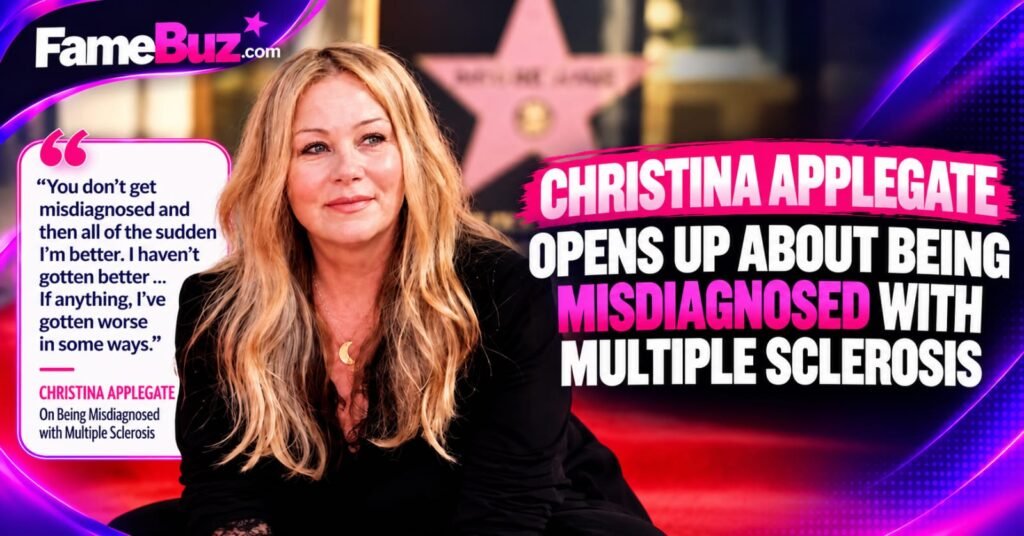
Christina Applegate Reveals She Was Misdiagnosed With Multiple Sclerosis After Five Years
Christina Applegate has shared a major development in her health journey: doctors have reconsidered the multiple sclerosis diagnosis she received in 2021. Speaking on her MeSsy podcast in October 2026, the actress explained that the change has not brought the relief outsiders might expect. Her symptoms remain, and she still wants to understand what is happening to her body.
The announcement changes the medical explanation Applegate has discussed publicly for five years, but it does not erase her experiences. She has described serious mobility difficulties, demanding treatment decisions, and uncertainty about her ability to work. Her latest account highlights the difference between correcting a diagnosis and finding an answer that actually helps a patient.
What Christina Applegate Revealed
Applegate discussed the development with Jamie-Lynn Sigler, her cohost on MeSsy. She said her medical team no longer believes she has multiple sclerosis, commonly called MS. The condition affects the central nervous system and can cause difficulties involving movement, sensation, vision, balance, and fatigue.
According to Applegate, her doctor initially presented the revised assessment as good news. She understood why someone might react that way. However, her everyday reality had not suddenly changed. She continued experiencing symptoms that had shaped her life since before her original diagnosis.
That distinction is central to understanding her announcement. Applegate was not saying she had recovered or that her previous struggles were imagined. She was describing a new uncertainty after years of believing doctors had identified the cause of those struggles.
Her comments also did not establish another diagnosis. Without a publicly confirmed explanation, reporting should avoid naming a replacement illness or predicting her medical future.
Why the News Felt Complicated
A serious diagnosis can be frightening, but it can also provide structure. Patients may finally have language for symptoms, a treatment plan, and a clearer way to explain their needs to relatives, colleagues, and friends.
Applegate spent years speaking about life with what she understood to be MS. That understanding influenced her public interviews, podcast conversations, and expectations about her health. Learning that the diagnosis was incorrect removed an explanation without removing the physical difficulties.
She made clear that she still experiences limitations affecting her mobility. The revised assessment therefore brought questions rather than a straightforward celebration. What caused the symptoms? Which medical evaluations might help? Would a different diagnosis eventually lead to more effective care?
Those questions remain unanswered publicly. They also illustrate why reactions to diagnostic changes vary. Some patients feel immediate relief. Others feel frustration or grief about lost time, especially when symptoms continue without a clear explanation.
Applegate’s response deserves to be understood on her own terms, without turning it into a dramatic recovery narrative.
How Her Original Diagnosis Became Public
In August 2021, Applegate announced that she had been diagnosed with multiple sclerosis. The disclosure attracted attention because she was a familiar television star working on a successful Netflix series.
At the time, she was filming Dead to Me, the dark comedy in which she starred alongside Linda Cardellini. The show centered on an unlikely friendship shaped by grief, secrets, and complicated personal choices.
Applegate subsequently discussed how difficult filming became as her symptoms affected her physical abilities. Production adjustments helped her complete the final season, but the experience required substantial effort.
Her openness gave viewers a glimpse of challenges that often remain invisible in finished television episodes. A scene that looks effortless on screen may involve long shooting days, repeated movements, and demanding schedules.
The actress did not describe her condition merely as an inconvenience. She explained that it had changed daily activities and made professional decisions more difficult.
Her 2021 announcement became an important reference point for later interviews. The new information changes that diagnostic history, not the fact that she experienced those challenges.
What Led Doctors to Reconsider MS
During the podcast discussion, Applegate described medical developments that prompted another look at her diagnosis. Reporting on her comments indicated that her physician reconsidered aspects of her treatment and test results.
She referred to changes involving an infusion treatment and the behavior of B cells, which are part of the immune system. The results reportedly encouraged a broader reassessment of the original conclusion.
Applegate also discussed earlier imaging and testing, including MRI scans and a spinal tap. Those procedures can form part of an evaluation for multiple sclerosis, although neither should be interpreted in isolation.
The precise reasoning behind her doctors’ conclusion has not been established through independently available medical records. Her public account is therefore the appropriate basis for describing what happened.
It would be irresponsible to claim that one specific test proves she never had MS or that a particular treatment caused her ongoing symptoms. The publicly known information does not support those conclusions.
What is clear is that her medical team has changed its assessment and that further investigation is needed to understand her condition.
Understanding Multiple Sclerosis
Multiple sclerosis is a disease involving the central nervous system, including the brain and spinal cord. In MS, immune activity damages myelin, the protective material surrounding nerve fibers, and can disrupt communication within the nervous system.
Symptoms differ widely. Some people experience visual disturbances, numbness, muscle weakness, fatigue, or difficulties with balance. Others may develop more significant mobility limitations. Symptoms can fluctuate, and the course of the disease is not identical for everyone.
Diagnosing MS requires more than recognizing a familiar list of symptoms. Physicians consider a patient’s history, neurological examination, MRI findings, and sometimes laboratory tests. They must also evaluate whether another condition better explains the evidence.
This matters because many symptoms associated with MS are not unique to that disease. Fatigue, tingling, weakness, and dizziness can occur for several reasons.
Brain lesions seen on imaging also require careful interpretation. Their location, appearance, and clinical context are important, and the presence of lesions alone does not automatically confirm MS.
Patients should not use a celebrity’s experience to interpret their own test results. Individual diagnosis and treatment decisions belong with qualified clinicians familiar with the person’s complete medical history.
Why Diagnostic Errors Can Happen
Complex neurological conditions sometimes require extended investigation. Early symptoms may be nonspecific, tests may produce uncertain findings, and the medical picture can change as additional information becomes available.
Specialists evaluating possible MS must distinguish it from conditions with overlapping symptoms or imaging patterns. A diagnosis may later be reconsidered when new evidence challenges the original interpretation.
This does not mean that every uncertain case involves negligence. Nor does it mean that patients should stop medication or assume their own diagnoses are wrong.
Instead, Applegate’s experience illustrates the importance of ongoing clinical review when the available evidence and a patient’s symptoms do not fit together clearly.
A second opinion from an appropriately qualified specialist can sometimes help clarify difficult cases. Patients considering that option should discuss their concerns with their treating clinicians, particularly before making changes to prescribed treatment.
Diagnostic accuracy matters because different conditions may require different approaches to care. Yet an accurate diagnosis can take time, and uncertainty can be emotionally exhausting.
For Applegate, the reassessment has produced a new question that remains central to her health: What explains the symptoms she continues to experience?
The Impact on Her Acting Career
Applegate built a career across television, film, and theater long before her health became a major public topic. She became widely known as Kelly Bundy on Married… with Children and later starred in Samantha Who?, Anchorman, and Dead to Me.
Her performances often combined sharp comedic timing with emotional range. Dead to Me, in particular, offered a role that moved between dark humor, grief, anger, and vulnerability.
Her health difficulties emerged during production of the show’s final season. Applegate has described needing assistance and accommodations while working, making the completed season especially meaningful to her.
The experience also influenced how she discussed future acting opportunities. She expressed uncertainty about whether her physical condition would allow her to return to demanding on-camera roles.
Those statements reflected real limitations, regardless of the diagnosis she had received at the time.
The latest announcement should not be interpreted as confirmation that she is returning to acting. No new project or professional comeback has been established through this health update.
Her career remains an important part of the story because it helps explain how deeply the symptoms affected her independence and daily routine.
Jamie-Lynn Sigler and the MeSsy Podcast
Applegate cohosts MeSsy with Jamie-Lynn Sigler, who is known for portraying Meadow Soprano on The Sopranos. Sigler has publicly discussed living with multiple sclerosis for many years.
The podcast has offered conversations about illness, relationships, emotional well-being, work, and the challenges of managing unpredictable symptoms.
Its appeal comes partly from the hosts’ willingness to speak without pretending that difficult experiences always produce inspirational conclusions.
Before the new announcement, the two actresses understood themselves to share an MS diagnosis. Applegate’s revised medical assessment changes that aspect of their conversations, but it does not remove their shared experiences of uncertainty and physical difficulty.
The podcast also provides Applegate with a familiar place to explain her response in her own words. That is especially valuable when headlines might otherwise simplify a complicated medical development.
Sigler’s experience remains her own. Applegate’s revised diagnosis should not be used to draw conclusions about Sigler’s health or the accuracy of other people’s diagnoses.
What the Announcement Means for Her Advocacy
Since revealing her original diagnosis, Applegate has spoken openly about mobility problems and the emotional consequences of chronic illness. Her visibility helped bring public attention to experiences that many people face privately.
Learning that she was misdiagnosed has understandably complicated her relationship with that advocacy. She has expressed concern about how people in the MS community might interpret the change.
However, her earlier statements reflected the medical information she believed was correct. There is no evidence that she intentionally misled audiences about her health.
Sharing personal experiences is different from claiming to offer definitive medical advice. Applegate described what she was going through, and those experiences remain meaningful even when their medical explanation changes.
Her story may now help broaden the conversation to include people who face prolonged diagnostic uncertainty.
Patients sometimes build routines, support networks, and expectations around a diagnosis. Revising that diagnosis can create another adjustment, especially when no clear alternative is available.
The most respectful approach is to acknowledge both realities: Applegate’s earlier advocacy mattered to audiences, and her present uncertainty deserves equal consideration.
Her Symptoms Have Not Disappeared
One point deserves particular emphasis: Applegate has not announced that she is symptom-free.
She has described continuing difficulties with walking and everyday mobility. Reports on her podcast comments also describe ongoing physical therapy and the use of assistance for some activities.
These are meaningful details because the phrase misdiagnosed with MS could otherwise create the impression that she is suddenly healthy.
That would be misleading.
A diagnosis is a clinician’s explanation for symptoms and findings. Changing that explanation does not necessarily change the symptoms themselves.
It also does not establish what will happen next. Some medical conditions respond to targeted treatment once identified, while others require longer investigation or ongoing symptom management.
Nothing Applegate has publicly disclosed supports a prediction about her recovery or future mobility.
Readers should also avoid interpreting photographs or brief public appearances as reliable measures of her health. A person’s visible appearance cannot establish the cause or severity of neurological symptoms.
Her own statements provide the clearest available account of how the situation affects her.
Why the Story Matters Beyond Hollywood
Celebrity health announcements can encourage wider discussion of medical issues, but they can also spread confusion when complicated information is reduced to a dramatic headline.
Applegate’s experience offers a useful opportunity to explain that diagnosis is sometimes an evolving process.
Doctors rely on the best available evidence, but additional testing and specialist review may change their conclusions. Patients can experience substantial symptoms even when clinicians have not yet identified their cause.
The story also highlights the emotional importance of being heard. Persistent symptoms deserve careful attention whether or not a diagnosis has been confirmed.
At the same time, one person’s experience should not be treated as proof that a disease is routinely misdiagnosed or that established treatments are ineffective.
Such claims require population-level research, not a single celebrity account.
Responsible coverage can recognize the significance of Applegate’s experience without turning it into generalized medical advice.
It can also acknowledge the difference between reporting her personal statements and independently verifying confidential clinical details.
That distinction protects both the accuracy of the article and the actress’s right to medical privacy.
What Happens Next for Christina Applegate?
Applegate has indicated that further medical investigation is planned. The next steps may involve additional evaluation, but the details of her doctors’ approach have not been publicly established.
As of October 21, 2026, she has not announced a confirmed replacement diagnosis.
That uncertainty should remain central to future reporting. A new explanation may eventually emerge, but it would be premature to suggest what it will be.
Any subsequent update should rely on Applegate’s own public disclosures or credible reporting based on clearly identified sources.
For now, she continues navigating physical symptoms while seeking answers from her medical team.
Her experience is not a simple story of a frightening diagnosis being reversed and everything returning to normal.
It is a story about living with unresolved health problems, adapting to changing medical information, and trying to understand what comes next.
A Difficult New Chapter
Christina Applegate’s announcement marks a significant turning point in a health journey she has discussed publicly since 2021.
Doctors have reconsidered her multiple sclerosis diagnosis, but she continues to experience symptoms that have affected her career, independence, and daily life.
The change has brought fresh uncertainty rather than a confirmed recovery.
Her willingness to discuss that uncertainty offers a more realistic picture of what a revised diagnosis can mean. Answers may change, even when a patient’s experiences remain painfully consistent.