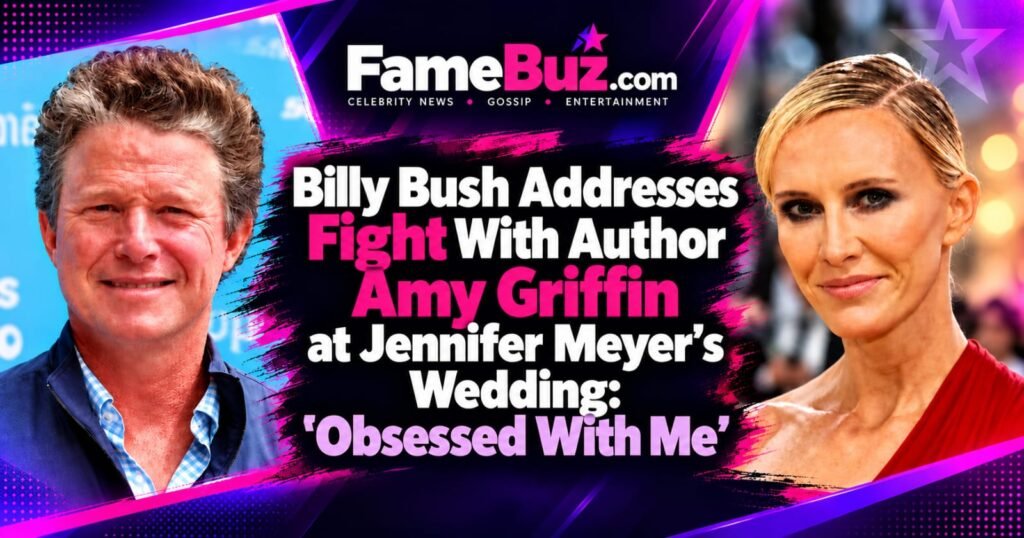
Billy Bush Addresses Alleged Amy Griffin Confrontation at Jennifer Meyer’s Wedding
Billy Bush has publicly described an alleged confrontation with author Amy Griffin at Jennifer Meyer’s wedding in Hawaii, connecting the uncomfortable encounter to his previous coverage of Griffin’s memoir and an ongoing legal dispute. The former Access Hollywood host discussed the incident on the October 19, 2026, episode of his Hot Mics podcast, several days after Meyer married music executive Geoffrey Ogunlesi on October 10.
Bush claimed Griffin challenged him during the festivities because she objected to his commentary about her book, The Tell. His account attracted coverage from Entertainment Weekly, Us Weekly, and TMZ. However, the detailed description of Griffin’s behavior comes principally from Bush, and it should not be treated as an independently established account of everything that happened.
Billy Bush Explains the Wedding Encounter
On Hot Mics, Bush said he sensed tension involving Griffin after arriving on Lanai for the wedding weekend. He alleged that she appeared upset with him and discouraged other guests from speaking with him. These observations reflect Bush’s interpretation of the atmosphere, rather than findings independently confirmed by attendees.
Bush said the two eventually interacted during the celebration. According to his telling, Griffin confronted him about his reporting on The Tell and the allegations surrounding the memoir. He described the exchange as uncomfortable and argued that a wedding was not an appropriate place to debate a contentious publishing controversy.
He also maintained that he tried to keep the conversation from escalating. That characterization is his own. Without a full independent account of the interaction, it is not possible to determine precisely how either person behaved or how nearby guests understood the exchange.
The important confirmed development is that Bush chose to address the reported incident publicly. His podcast episode provides a primary source for what he says happened, even though it cannot independently verify the actions he attributes to Griffin.
Why Bush and Griffin Had a Disagreement
The alleged encounter followed Bush’s coverage of Griffin’s 2025 memoir, The Tell. The book discusses Griffin’s account of childhood sexual trauma and her process of understanding difficult memories. Its sensitive subject matter drew attention well before the wedding, particularly after a former classmate challenged aspects of the story.
Joleene Altum filed legal claims alleging that Griffin’s memoir incorporated experiences belonging to Altum. Griffin has denied the allegations and pursued a defamation claim against her former classmate. The competing positions remain disputed, and the existence of lawsuits does not establish that either side’s allegations are true.
Bush previously discussed the controversy on his podcast and raised questions about the memoir. His public skepticism is relevant because he identified that coverage as the reason Griffin was upset with him. It does not, by itself, settle any factual question about the book or the legal proceedings.
Careful reporting requires separating three matters: Griffin’s published account, the allegations raised in litigation, and Bush’s description of a personal encounter. They are connected, but evidence supporting one does not automatically establish the others.
What Is Confirmed About Jennifer Meyer’s Wedding
Meyer married Geoffrey Ogunlesi at the Four Seasons Resort Lanai in Hawaii on October 10, 2026. Vogue published an account of the ceremony, and the Los Angeles Times separately reported on the celebration. The wedding brought together relatives, friends, and recognizable figures from the entertainment industry.
One widely discussed detail was the officiant: actor Tobey Maguire, Meyer’s former husband. Meyer spoke positively about his participation in an interview with Vogue. Their continued family connection helped make the ceremony distinctive, independent of the later attention surrounding Bush and Griffin.
The celebration also drew guests including Demi Moore and Leonardo DiCaprio, according to entertainment coverage. Their presence helps explain why an alleged disagreement at the event attracted interest, but it does not establish what occurred between the two principal figures.
Meyer’s wedding was first and foremost a personal celebration. Reporting on the Bush-Griffin dispute should not imply that the couple’s marriage or the overall event was defined by a disagreement involving guests.
Bush’s Account of Demi Moore’s Presence
Bush also mentioned Demi Moore while describing the moments before the alleged confrontation. He said he observed Moore speaking with Griffin and interpreted their interaction as encouragement for Griffin to approach him. He further described an awkward moment involving Griffin’s belongings.
Those details have circulated because Moore is a familiar Hollywood figure. Nevertheless, her presence does not make her a participant in the underlying dispute, and the reporting reviewed does not independently establish her perspective on the conversation.
It would therefore be inaccurate to say Moore took a side or deliberately intervened without reliable confirmation. Bush’s recollection can be reported as his account, but readers should understand the difference between what a participant claims to have observed and what another person has publicly verified.
Entertainment Weekly reported seeking comment from representatives connected to the incident. A request for comment is not itself a response, and an absence of an immediate public statement should not be interpreted as agreement with Bush.
Claims Involving Bush’s Girlfriend
Bush additionally alleged that Griffin approached his girlfriend, Ali, during the wedding festivities. According to him, Griffin questioned their relationship and accused him of mistreating her through his coverage. Bush presented that alleged exchange as evidence that the disagreement had become personal.
The conversation has not been independently established through a complete statement from everyone involved. Accordingly, its precise wording and tone should not be treated as confirmed facts. Nor should a reported remark be used to infer anyone’s private feelings or motivations.
Bush criticized the idea of raising such a dispute at someone else’s wedding. That reaction is relevant to understanding his public comments, but it remains his assessment of the situation rather than a neutral finding about Griffin’s intentions.
The broader issue is the tension that can develop when public commentary about a sensitive subject leads to an unexpected encounter away from cameras and microphones. Such moments are difficult to reconstruct accurately from a single participant’s recollection.
A Conversation With John Griffin
Bush said he later spoke with Griffin’s husband, John Griffin. He characterized that conversation as calmer and more constructive than the earlier exchange. The podcast discussion suggests that Bush viewed the later interaction differently, although John Griffin’s independent account was not established in the reporting reviewed.
There is no verified basis to describe that discussion as a reconciliation, an apology, or a resolution of the legal controversy. A civil conversation between two people would not determine the accuracy of claims involving a third person or settle questions about a published memoir.
This detail nevertheless adds useful context. Bush did not describe every interaction during the wedding weekend as confrontational. His distinction between the alleged encounter with Amy Griffin and his later discussion with her husband forms part of the public narrative he offered listeners.
The Tell and the Importance of Attribution
The Tell concerns intensely personal experiences. Reporting about challenges to such a memoir requires care, particularly when the dispute involves accounts of sexual abuse and contested memories. The allegations made by Altum are serious, as are the reputational implications for Griffin.
An allegation in a lawsuit is not equivalent to a judicial finding. Griffin’s denial is likewise an important part of the record, but it does not mean a journalist can declare the dispute resolved. The appropriate approach is to identify who made each claim and avoid adopting either side’s language as established truth.
That standard also applies to Bush’s wedding account. It is accurate to report that he says Griffin confronted him. It would require stronger evidence to state without attribution that she behaved in a particular way, threatened someone, or intended to disrupt the celebration.
Readers deserve a clear distinction between confirmed public statements, independently documented events, and disputed descriptions of private behavior. Maintaining those boundaries is especially important when a celebrity story overlaps with litigation and sensitive personal history.
Tobey Maguire’s Unusual Role in the Ceremony
Maguire’s participation as officiant was among the wedding’s most independently documented details. The actor and Meyer were previously married and share children. Their decision to remain involved in one another’s family milestones drew attention because it departed from conventional expectations about former spouses.
In Vogue’s coverage, Meyer expressed happiness about the ceremony and the involvement of their family. Her comments centered on the significance of the occasion, not the reported disagreement between guests. The wedding also marked a new chapter for Meyer and Ogunlesi after their engagement and the arrival of their daughter.
The contrast matters editorially. One account concerns a couple celebrating their marriage; the other concerns Bush describing an uncomfortable interaction during that celebration. Combining the two should provide context, not transform the couple’s wedding into a spectacle centered on allegations that remain disputed.
When the Story Became Public
The reported encounter occurred during the October 10 wedding festivities. Bush discussed it publicly on October 19, and several entertainment publications reported his remarks on October 20. That chronology is essential for readers encountering the story on October 21.
The latest confirmed development is Bush’s public explanation, not a newly documented confrontation. Repeating the story with a misleading date could create the false impression that another incident occurred after the wedding. There is no verified basis for such a claim.
The podcast is the strongest source for Bush’s own words and stated perspective. Secondary coverage from Entertainment Weekly, Us Weekly, and TMZ helps establish how his remarks were reported, but those publications largely rely on the same underlying account for the private exchange.
Multiple articles repeating one participant’s story do not automatically provide independent corroboration. Responsible coverage should be transparent about that limitation instead of treating the number of headlines as proof.
Has Amy Griffin Responded?
A comprehensive, independently verified public response from Griffin addressing every detail of Bush’s October 19 account was not established in the sources reviewed. That does not mean she has accepted his characterization or that she has no perspective on the incident.
Griffin has disputed allegations connected to the separate memoir controversy, but her legal response should not be presented as a direct answer to every wedding claim. The book litigation and the reported encounter concern different questions, even if Bush believes they are connected.
If Griffin, Moore, or another attendee offers a verifiable account, that information could materially change how the episode is understood. Any update should identify its source and publication date and distinguish firsthand observations from speculation.
Until then, describing the incident as an alleged confrontation according to Bush is more accurate than declaring either party responsible for an independently proven altercation.
What Happens Next?
No verified announcement establishes a planned joint interview, public reconciliation, or legal action specifically arising from the wedding encounter. Bush’s comments may invite further responses, but predicting them would be speculation.
The separate litigation involving The Tell remains the more consequential issue because it concerns formal allegations that must be evaluated through legal processes and evidence. Any significant court development would warrant its own reporting rather than being folded casually into wedding gossip.
For Bush, the October 19 podcast episode placed his perspective on the record. For Griffin, the available coverage leaves important questions about her own recollection unanswered. For Meyer and Ogunlesi, the wedding remains an independently documented family milestone whose significance extends beyond the reported disagreement.
The Bottom Line
Billy Bush has described a tense encounter with Amy Griffin at Jennifer Meyer’s Hawaii wedding and connected it to his earlier reporting about her memoir. His account is newsworthy because he addressed the matter publicly, but the private details remain primarily his version of events.
The wedding date, location, and Maguire’s role are independently documented. The disputed allegations surrounding The Tell remain separate from those confirmed details. Until additional firsthand evidence or verified responses emerge, clear attribution offers readers the fairest understanding of what is known, what is contested, and why the story has attracted attention for everyone involved.