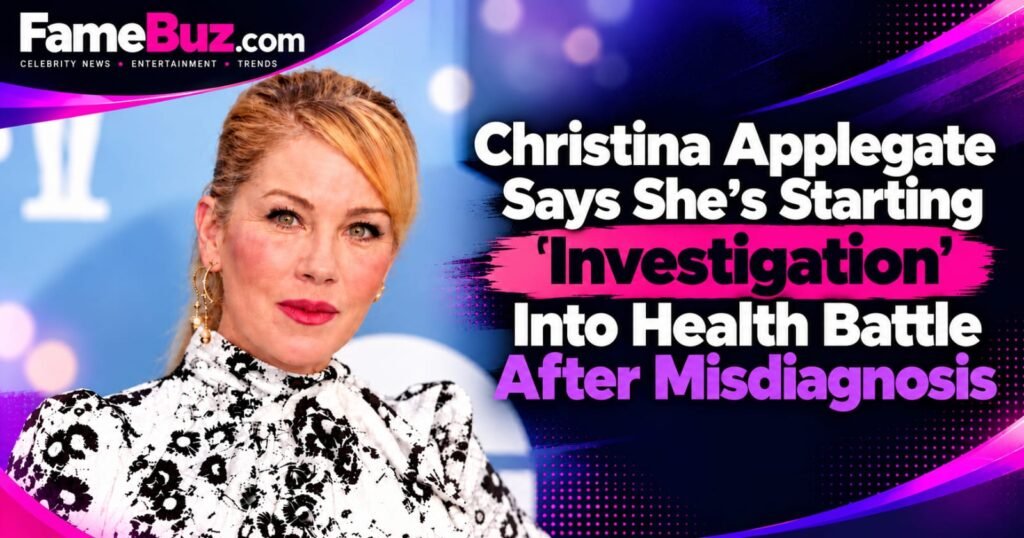
Christina Applegate Begins New Health Investigation After MS Misdiagnosis
Christina Applegate is searching for medical answers after revealing that the multiple sclerosis diagnosis she received in 2021 was incorrect. The Emmy-winning actress shared the unexpected development during an October 20, 2026, episode of her MeSsy podcast, explaining that her physical symptoms continue despite the change in diagnosis.
The 54-year-old actress, known for Dead to Me, Married… with Children, and Anchorman, said she plans to pursue further medical investigation while continuing physical therapy.
Although learning she does not have multiple sclerosis might initially sound encouraging, Applegate explained that the news has left her confused rather than relieved.
Her symptoms have not disappeared, and doctors have not publicly identified another condition responsible for them.
The announcement represents a major turning point in a health journey Applegate has discussed openly for five years.
Christina Applegate Reveals Her MS Diagnosis Was Incorrect
Applegate first publicly announced her multiple sclerosis diagnosis in August 2021. Since then, she has spoken candidly about physical pain, mobility challenges, emotional difficulties, and changes to her professional life.
During her latest podcast appearance, however, she revealed that her doctor had reconsidered that diagnosis.
According to Applegate, the reassessment followed medical observations made after she stopped receiving an infusion treatment.
Her physician eventually informed her that she did not have MS.
The announcement created an unexpected emotional reaction.
While people around her reportedly viewed the news positively, Applegate struggled to celebrate because she continued experiencing the same debilitating symptoms.
The revised diagnosis did not mean she had recovered. It meant the explanation for her condition was no longer considered accurate.
That distinction is central to understanding her latest health update.
For years, Applegate had organized her medical care and personal expectations around an MS diagnosis. Now she faces the uncertainty of determining what is actually causing her difficulties.
Why Christina Applegate Is Starting a New Medical Investigation
During the October 20 episode of MeSsy, Applegate explained that she was preparing to begin investigating her symptoms with medical specialists.
She also disclosed that she was attending physical therapy three times weekly.
Her comments indicated that the new diagnostic process had not yet fully begun.
The actress expressed uncertainty about which specialists she should consult because the underlying problem remains unidentified.
That uncertainty highlights an important challenge for patients whose original diagnoses are reconsidered.
Without a confirmed explanation, determining the most appropriate medical pathway can become complicated.
Applegate has not announced a new diagnosis or confirmed which additional medical tests she will undergo.
Her investigation should therefore be understood as an effort to obtain medical clarity rather than evidence that another condition has already been identified.
There is also no verified public basis for interpreting her comments as an allegation of medical negligence.
For now, her priority appears to be understanding her symptoms and identifying appropriate treatment options with qualified professionals.
The Emotional Impact of Learning She Was Misdiagnosed
Applegate has explained that discovering she does not have MS has been emotionally difficult.
A diagnosis can provide patients with a framework for understanding symptoms, evaluating treatment options, and planning daily activities.
Losing that explanation after several years can create uncertainty even when the revised information initially appears positive.
For Applegate, the situation is particularly complicated because her physical condition has not improved.
She continues to experience symptoms that significantly affect her mobility and independence.
Being told she does not have MS has not eliminated the challenges she faces every day.
The actress has described feeling unsettled by the absence of an explanation for those difficulties.
Her reaction illustrates why medical news cannot always be categorized simply as good or bad.
Patients may experience relief, disappointment, confusion, and anxiety simultaneously when a diagnosis changes.
Those feelings can be especially complicated when someone has already adjusted major life decisions around a particular medical condition.
Applegate’s public discussion offers insight into that emotional uncertainty without suggesting that every patient will respond similarly.
Christina Applegate Continues Experiencing Serious Physical Symptoms
One of the most important aspects of Applegate’s announcement is that her symptoms remain significant.
She has previously discussed difficulty walking, persistent pain, and the need for mobility assistance.
During her latest podcast discussion, she explained that she still sometimes requires a wheelchair when attending medical appointments.
She has also described being unable to walk relatively short distances without difficulty.
These experiences have affected ordinary activities and professional commitments.
The change in diagnosis does not erase those limitations.
Applegate continues to experience genuine physical problems, even though their medical explanation remains uncertain.
This distinction is particularly important in reporting about misdiagnosis.
An incorrect diagnosis does not establish that a patient’s symptoms were imagined, exaggerated, or insignificant.
It means the available medical evidence no longer supports the original explanation.
Applegate has not publicly disclosed enough information to determine the cause of her symptoms independently.
Speculation about alternative diseases would therefore be inappropriate.
Her continuing physical difficulties remain the most immediate concern as she prepares for further evaluation.
What Is Multiple Sclerosis?
Multiple sclerosis, commonly called MS, is a chronic disease affecting the central nervous system.
The condition involves immune system activity that damages myelin, the protective covering surrounding nerve fibers.
This damage can interfere with communication between the brain, spinal cord, and other parts of the body.
Symptoms vary considerably between individuals.
Common experiences can include fatigue, numbness, muscle weakness, balance difficulties, visual disturbances, and changes in coordination.
Some people experience episodes of worsening symptoms followed by periods of improvement.
Others may experience more gradual progression.
The condition can affect mobility, employment, relationships, and daily routines.
However, experiencing symptoms associated with MS does not automatically establish an MS diagnosis.
Several other medical conditions can produce similar neurological symptoms.
That overlap is one reason specialists must carefully evaluate clinical findings before confirming the disease.
Treatment decisions depend on the individual’s medical history, examination findings, and diagnostic results.
Patients concerned about their own diagnoses should consult their healthcare professionals rather than drawing conclusions from another person’s experience.
Why Multiple Sclerosis Can Be Difficult to Diagnose
Unlike some conditions that can be identified through a single definitive laboratory result, multiple sclerosis requires a combination of medical evidence.
Neurologists typically consider a patient’s symptoms, neurological examination, imaging results, and relevant medical history.
Magnetic resonance imaging can help identify abnormalities associated with damage in the central nervous system.
Additional tests may sometimes provide supporting information.
Doctors must also evaluate whether another condition could better explain the findings.
This process is known as differential diagnosis.
It becomes particularly important when symptoms overlap with other neurological or inflammatory conditions.
Medical knowledge and diagnostic standards have also developed over time.
As new evidence becomes available, physicians may reconsider an earlier conclusion.
That does not automatically establish that a doctor acted improperly.
It reflects the reality that some complex medical conditions can be difficult to distinguish.
A careful diagnostic reassessment may be necessary when new findings conflict with an established diagnosis.
Applegate’s case has renewed public discussion about these challenges.
Nevertheless, her individual medical records are not publicly available, making independent conclusions about the original diagnostic process impossible.
Medical Experts Discuss the Risk of MS Misdiagnosis
Applegate’s podcast discussion included medical context from neurologist Dr. Marwa Kaisey of Cedars-Sinai.
Kaisey addressed the difficulties involved in diagnosing multiple sclerosis and explained why diagnostic errors can occur.
Research has identified cases in which people initially diagnosed with MS were later found to have another condition.
Some studies involving particular patient populations have reported substantial rates of diagnostic reconsideration.
However, those findings should not be interpreted as proving that the same percentage applies to every person diagnosed with MS.
Results depend on the patients studied, the diagnostic criteria used, and the healthcare setting.
Specialty clinics evaluating uncertain cases may encounter different patterns from general neurological practices.
Misdiagnosis can have important consequences.
Patients may receive treatments that are not appropriate for their actual condition, while identification of another medical problem may be delayed.
At the same time, an accurate and timely MS diagnosis remains essential for patients who genuinely have the disease.
The appropriate response is careful clinical evaluation, not widespread distrust of established diagnoses.
Applegate’s experience reinforces the importance of discussing unexpected findings and unresolved symptoms with qualified specialists.
Jamie-Lynn Sigler’s Role in the MeSsy Podcast
Applegate co-hosts MeSsy with actress Jamie-Lynn Sigler, widely recognized for portraying Meadow Soprano on The Sopranos.
Sigler has publicly discussed living with multiple sclerosis for many years.
Their podcast developed into a platform for conversations about health, disability, relationships, emotional challenges, and everyday life.
The actresses have frequently approached difficult subjects with a combination of candor and humor.
Their discussions offer listeners personal perspectives rather than formal medical advice.
Applegate’s latest revelation changes an important part of the podcast’s original context.
Although Sigler continues to live with MS, Applegate now understands that her own diagnosis was incorrect.
Nevertheless, their conversations remain relevant to broader experiences involving chronic symptoms and medical uncertainty.
The two actresses have built their discussions around personal honesty and the difficulties of adapting to changing physical circumstances.
Their experiences demonstrate that serious health challenges can affect people differently, even when they initially appear to share a diagnosis.
The podcast also provides Applegate with an established platform for sharing developments directly with listeners.
How Applegate’s Health Challenges Affected Her Career
Christina Applegate has enjoyed a successful entertainment career spanning several decades.
She became a household name through her portrayal of Kelly Bundy on the television sitcom Married… with Children.
Her later credits included Samantha Who?, Up All Night, and numerous film appearances.
She also earned critical acclaim for playing Jen Harding in Netflix’s Dead to Me.
The series became particularly significant during her health difficulties.
Applegate experienced substantial physical challenges while completing its final season.
She has previously discussed how those difficulties affected filming and required adjustments during production.
Her willingness to continue working attracted considerable public attention.
However, the experience also demonstrated how serious physical symptoms can change professional possibilities.
The reversal of her MS diagnosis does not mean those workplace challenges were any less real.
Applegate has not announced that the new medical information will allow her to resume a regular acting schedule.
Any claims about an imminent professional comeback would therefore be speculative.
Her immediate public focus remains on understanding her health.
Her Years of Public Health Advocacy
Following her original diagnosis, Applegate became an outspoken participant in conversations about multiple sclerosis.
She discussed symptoms, mobility assistance, emotional struggles, and the challenges of maintaining independence.
Her openness helped audiences better understand the practical consequences of living with serious physical limitations.
She also connected with people who appreciated hearing a recognizable public figure discuss difficult experiences without presenting an unrealistically positive picture.
The revised diagnosis introduces complexity into that advocacy history.
Applegate believed she was speaking from the experience of someone living with MS.
She now knows that her medical situation was different from what she previously understood.
However, the symptoms she described and the challenges she experienced remain part of her history.
Her story can still contribute to conversations about disability, chronic symptoms, and the uncertainty surrounding complex diagnoses.
It is important, however, not to treat her experience as evidence that other people’s diagnoses are incorrect.
Medical decisions require individualized evaluation.
Public awareness should encourage informed discussions with healthcare professionals rather than unsupported conclusions.
What Happens Next for Christina Applegate?
Applegate has indicated that she intends to continue physical therapy while pursuing additional medical evaluation.
She described plans to begin investigating the underlying cause of her symptoms following the podcast announcement.
The precise specialists involved have not been publicly identified.
There is also no confirmed timetable for reaching another diagnosis.
Further developments will depend on medical assessments and any information Applegate chooses to disclose.
Her privacy remains important despite her willingness to discuss aspects of her health publicly.
Until additional verified information becomes available, reporting should avoid predicting particular test results or treatments.
The confirmed development is that Applegate is seeking answers after learning her previous MS diagnosis was incorrect.
Her continuing symptoms make this an unresolved medical situation.
For fans following her story, the most responsible approach is to distinguish confirmed statements from speculation.
Applegate’s announcement is significant, but it does not establish what condition she has or how her health may change.
A New Chapter in Christina Applegate’s Health Journey
Christina Applegate’s latest revelation represents an unexpected turning point after five years of publicly discussing multiple sclerosis.
She has learned that the diagnosis she received in 2021 was incorrect, yet her physical symptoms remain serious.
The news has brought uncertainty rather than the immediate relief some might expect.
Her next steps involve continued therapy, further medical investigation, and efforts to understand what has been affecting her health.
The actress has not announced another diagnosis or a definitive explanation.
For Applegate, the central challenge is finding answers while continuing to manage symptoms that have already changed her daily life.
Her experience also highlights the complexity of medical diagnosis and the importance of reassessing unexplained symptoms when new evidence emerges.
As she begins this next chapter, her public comments offer a reminder that a revised diagnosis does not necessarily mean a patient’s health problems have ended.
For now, Applegate remains focused on understanding her condition and determining what comes next.