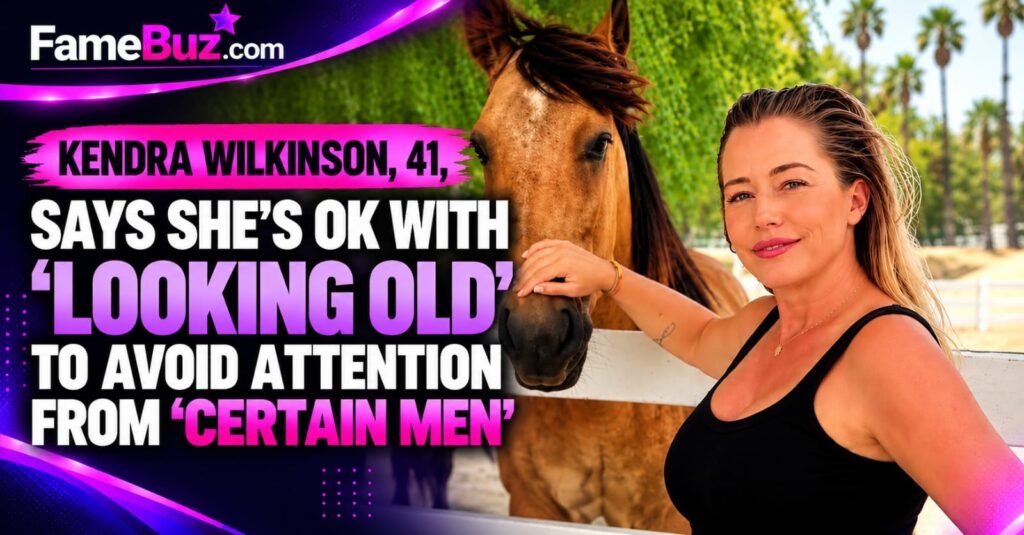
Kendra Wilkinson, 41, Says She’s Fine With ‘Looking Old’ to Avoid Attention From Certain Men
Kendra Wilkinson is making it clear that she no longer feels responsible for maintaining a particular appearance to satisfy other people. The 41-year-old reality television personality recently addressed unwanted criticism about her looks, explaining that she is comfortable growing older, even if that means losing male followers who expect her to maintain the image associated with her earlier career.
The former The Girls Next Door star shared the message through Instagram Stories after a man reportedly suggested that she needed a makeover beneath a social media post about her children’s sporting activities. Wilkinson questioned why strangers believed she owed them a particular appearance and emphasized that she was happy with her life.
Her response quickly attracted attention because it addressed a subject she has discussed repeatedly: the pressure women face to remain youthful, attractive and familiar to audiences who first encountered them years ago.
For Wilkinson, personal happiness, family life and freedom from unwanted judgment now matter more than preserving a specific image for social media followers. Her remarks also offer a glimpse into how her priorities have evolved since she became famous in her early twenties.
Kendra Wilkinson Responds to Criticism About Her Appearance
Wilkinson’s latest comments followed an interaction she described on Instagram Stories on October 20, 2026. According to Us Weekly, she explained that a man had suggested she needed a makeover in response to a post about her children’s sports activities.
The comment appeared to frustrate Wilkinson because her original post was about her family, not an invitation for strangers to evaluate her appearance.
“It’s so weird the fact people think I owe them that,” she wrote, according to Us Weekly’s report of her Instagram Story.
Wilkinson then emphasized that she was “happy and free,” making clear that she did not intend to change her appearance simply because someone online preferred a different look.
Her reaction was direct but centered on personal boundaries. She did not suggest that every follower was disrespectful or that she wanted to stop engaging with her audience altogether. Instead, she challenged the expectation that public visibility gives strangers the right to dictate how she should look.
That distinction is important in understanding the story. Celebrities regularly share photographs, family updates and glimpses of their everyday lives, but those posts can attract comments that have little to do with the original subject.
In Wilkinson’s case, a post about her children reportedly became an opportunity for someone to criticize her appearance. Her response redirected the conversation toward what she considers important in her life today.
The incident also reflects a familiar challenge for women in entertainment, who often face scrutiny over their looks long after their original projects have ended.
Rather than treating the criticism as something she must correct, Wilkinson indicated that she was comfortable moving forward on her own terms.
Why Kendra Wilkinson Is Comfortable Losing Certain Male Followers
The most attention-grabbing part of Wilkinson’s statement was her willingness to lose certain male viewers as she grows older.
She explained that she had been in a phase of wanting to lose some male followers, “even if it takes looking old,” according to Us Weekly’s October 22 report.
Wilkinson also made clear that she had little interest in pleasing men whose attention depended on her maintaining a particular appearance.
Her words should not be interpreted as an announcement that she intends to make herself look older. Rather, she was expressing acceptance of natural aging and indifference toward losing followers who disapprove of it.
She also distinguished between unwanted attention and respectful support. In the same message, Wilkinson acknowledged that she appreciates the men who treat her respectfully.
That qualification matters because her comments were directed toward a particular type of behavior, not every man who follows her online.
Her message suggests that she would rather have an audience that respects her as a person than one that expects her to maintain an image for its entertainment.
For a celebrity whose early career was closely associated with glamour and appearance, that position represents a meaningful change in emphasis.
Wilkinson has spent years being recognized for a public image established during reality television’s popularity in the 2000s. Today, she appears more interested in defining her life around her current priorities than meeting expectations connected to that earlier period.
Her response also demonstrates how social media can become a place where public figures establish boundaries directly. Instead of allowing every critical comment to dictate the conversation, Wilkinson used her own platform to explain what she is no longer willing to prioritize.
From Playboy Fame to a Different Stage of Life
Wilkinson became widely known through her association with Playboy founder Hugh Hefner and the E! reality television series The Girls Next Door.
The series introduced viewers to life at the Playboy Mansion and featured Wilkinson alongside Holly Madison and Bridget Marquardt. It became a recognizable part of reality television during the 2000s, bringing its cast members widespread attention.
Wilkinson was young when she entered that environment, and her public image became closely associated with glamour, beauty and the Playboy brand.
That early exposure helped make her a recognizable entertainment personality, but it also created expectations that can be difficult for public figures to escape.
When audiences first become familiar with a celebrity through a particular look or stage of life, they may continue to associate that person with the same image years later. Photographs and television appearances from earlier periods remain available, allowing viewers to compare the past with the present.
However, people change as they age, build families, pursue different careers and develop new priorities. A public image created in early adulthood cannot reasonably be expected to represent every later stage of someone’s life.
Wilkinson has continued working in entertainment after The Girls Next Door, including appearances in reality television projects such as Kendra and Kendra on Top. She has also pursued real estate, building a professional identity beyond the television environment that first brought her widespread recognition.
Her latest remarks suggest that she does not want her former image to determine how she must present herself today.
Wilkinson’s message is not that her past no longer matters; it is that her past should not dictate how she lives now.
That distinction helps explain why she is comfortable with the possibility of losing followers who expect her to remain the same person they remember from her early career.
Wilkinson Says Health, Happiness and Peace Matter More Than Looking Sexy
The October comments fit into a broader pattern of statements Wilkinson has made about aging and personal priorities.
In August 2026, she addressed criticism about her body and appearance in a social media post. Us Weekly and other entertainment outlets reported that she explained how her priorities had changed over the years.
“Sexy is the last thing I want to be nowadays,” Wilkinson wrote, according to Us Weekly.
She described her goals as focusing on health, happiness, success and spiritual well-being. She also addressed people who criticized her body or the way she had aged, saying that she was at peace with herself.
Her August message was important context for the October exchange because it showed that her latest response was not an isolated reaction to one negative comment.
Instead, she had already been discussing a shift away from the appearance-focused expectations associated with her earlier career.
Wilkinson also reflected on how much her life had changed since she was a young woman in the entertainment industry. She explained that she was comfortable no longer having the same appearance she had during her Playboy years.
That perspective acknowledges a simple reality: aging changes people, and there is no requirement to preserve the physical appearance associated with a particular age.
Her comments do not suggest that everyone should feel the same way about beauty or aging. They reflect her own experience and her decision to focus on the parts of life that bring her satisfaction.
For Wilkinson, those priorities now include her children, work, health and the freedom to enjoy life without allowing online criticism to determine her self-image.
Motherhood Is Central to Her Current Priorities
Family life has become an important part of Wilkinson’s public identity.
She shares two children with her ex-husband, former NFL player Hank Baskett. Their son, Hank IV, is 16, and their daughter, Alijah, is 12, according to reporting published in October 2026.
Wilkinson has discussed attending her children’s sporting events and enjoying everyday family moments. Those activities offer a different perspective on her life than the glamorous environment associated with her earliest television appearances.
The context of the makeover comment is particularly relevant because it reportedly appeared beneath a post about her children’s sports.
Wilkinson was sharing an aspect of family life, yet the response she described shifted attention back to her appearance.
Her frustration reflected the difference between what she wanted to share and what someone else expected from her.
In another social media post around the same period, Wilkinson described enjoying simple experiences such as watching her children play sports, cooking with her son and spending time with her daughter.
She presented those moments as meaningful parts of her current life.
These activities may not have the same visibility as a reality television series, but they illustrate the priorities she has chosen to emphasize publicly.
For parents, watching children grow and taking part in their everyday activities can become an important source of fulfillment. Wilkinson’s comments suggest that she values these experiences more than maintaining an image for people who may not understand her current life.
Her response also reinforces the idea that public figures can decide what they want to share without accepting every unsolicited opinion that follows.
She can post about her children without turning the conversation into a discussion about whether she needs a makeover.
The Pressure on Women to Look Younger
Wilkinson’s comments have also drawn attention to a broader issue in entertainment: the expectations placed on women to maintain a youthful appearance.
Women in the public eye often face conflicting demands. They may be criticized for looking different from how they appeared years ago, while also being judged if they make visible efforts to change or preserve their appearance.
These expectations can create an impossible standard in which natural aging becomes a subject of public debate.
For celebrities whose careers began in modeling, glamour or appearance-focused television, that scrutiny can be particularly persistent. Their early photographs remain easy to find, and audiences may compare those images with current appearances without considering the years that separate them.
Wilkinson’s career makes her comments especially relevant because her early public image was closely tied to the Playboy brand.
Her latest statement challenges the idea that she must continue to present herself according to expectations established when she was much younger.
She has indicated that she is comfortable looking her age and does not believe she owes anyone a particular appearance.
That message is personal rather than universal. Different people make different choices about makeup, fashion, cosmetic treatments and how they wish to present themselves. None of those choices should automatically be treated as the correct standard for everyone else.
The key issue in Wilkinson’s remarks is the freedom to make those choices without being pressured by strangers.
Her response suggests that she is no longer interested in allowing criticism to determine whether she feels confident or satisfied with her life.
Instead of trying to meet every expectation, she is willing to accept that some people may stop following her.
Social Media, Celebrity Boundaries and Unwanted Attention
Social media gives celebrities a direct way to communicate with fans, but it also exposes them to immediate and often unsolicited feedback.
A public figure can share a photograph, a family update or a professional achievement and receive comments about appearance, relationships or personal decisions.
Because those comments are visible, they can sometimes become a story in their own right, especially when a celebrity responds publicly.
Wilkinson’s Instagram Story demonstrates how a relatively ordinary interaction can become part of a larger conversation about celebrity culture.
The reported makeover suggestion was not a formal review of her work or a professional critique. It was an unsolicited opinion about her appearance beneath a post about her children.
Her response challenged the assumption that posting publicly means agreeing to meet the expectations of everyone who sees the content.
There is a difference between a public figure choosing to share aspects of life and accepting the idea that strangers have authority over personal choices.
Wilkinson’s message draws that line clearly. She appreciates respectful followers but is comfortable losing those whose attention depends on her looking a particular way.
That approach also reflects how social media audiences change over time. People who followed a celebrity for one reason may not remain interested as that person’s life and priorities evolve.
A public figure does not have to preserve every follower relationship at the expense of personal comfort.
Wilkinson’s statement suggests that she is willing to let her audience change as she changes.
What Her Latest Comments Mean for Her Public Image
Wilkinson’s remarks are newsworthy because they connect a recent social media interaction with a longer discussion about her public identity.
She became famous during a period when reality television often emphasized personal relationships, glamour and lifestyle. Her appearance was a prominent part of how audiences came to recognize her.
Now, she is speaking more openly about the freedom to age and the importance of not allowing old expectations to define her.
That does not mean she has rejected her career history or the people who supported her. Her comments specifically acknowledge that she appreciates respectful followers.
Rather, she appears to be distinguishing between people who are interested in her current life and those who expect her to maintain an earlier image for their benefit.
The distinction allows her to acknowledge her past while still moving forward.
It also gives context to her willingness to lose certain male followers. The statement is not an announcement that she is leaving social media, ending her career or making a dramatic change to her appearance.
It is a personal declaration about how she wants to be treated and which opinions she considers worth her attention.
As with any celebrity social media post, the public has only the information Wilkinson chose to share and the context described by reporting outlets. There is no basis for assuming that one exchange represents every aspect of her relationships with followers.
What can be reported is that she publicly rejected the expectation that she must maintain a particular look and said she was comfortable with the consequences.
What Happens Next for Kendra Wilkinson?
Wilkinson has not announced a new project or career decision directly connected to her remarks about aging. Her statement was a personal response to criticism, not a formal announcement about her professional plans.
There is also no verified indication that she intends to leave social media or make a specific change to her appearance because of the exchange.
Her recent public comments instead emphasize family, well-being, work and the freedom to live without constantly responding to other people’s expectations.
For longtime followers, this perspective may feel different from the image they remember from The Girls Next Door. However, the passage of time naturally brings changes in appearance, priorities and personal identity.
Wilkinson appears comfortable acknowledging those changes rather than attempting to preserve an image from an earlier stage of life.
Her latest response offers a simple message: respect matters more than unwanted attention, and a public figure should not have to satisfy every stranger who comments on a photograph.
At 41, she is describing a life in which watching her children grow, pursuing meaningful work and feeling comfortable with herself are more important than maintaining a particular image for male followers.
Ultimately, Kendra Wilkinson’s remarks are about personal freedom as much as aging. She is saying that growing older is not something she needs to apologize for, and she does not consider losing certain followers a reason to change who she is.
Her response does not require everyone to share her priorities. It simply makes clear that she intends to decide for herself what matters in this stage of her life.
For Wilkinson, that means accepting the changes that come with age, valuing respectful support and refusing to treat every negative opinion as a demand she must fulfill.