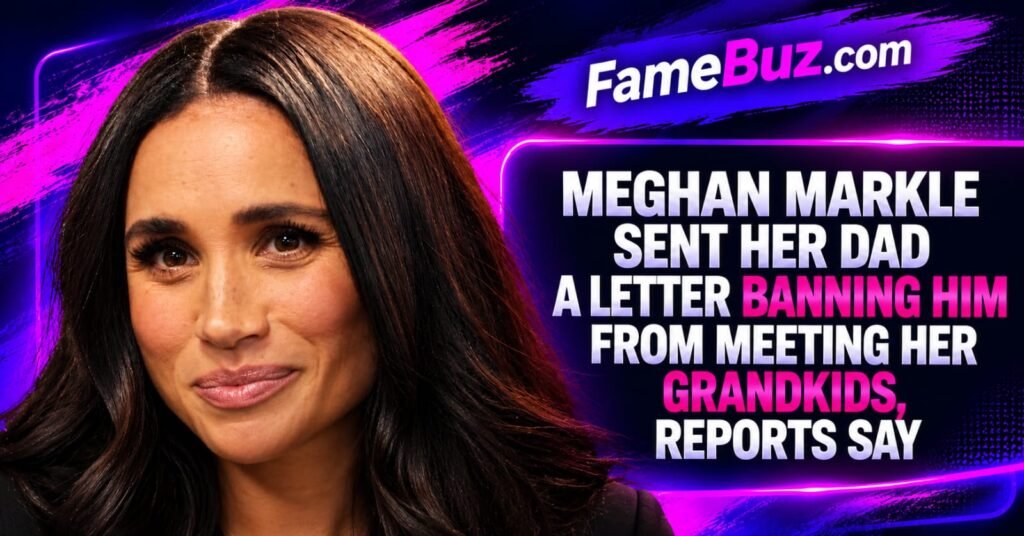
Meghan Markle’s Letter to Her Father Draws Attention as Police Review Handling of Allegations
Meghan, Duchess of Sussex, has returned to the headlines after reports emerged that she sent her estranged father, Thomas Markle Sr., a letter explaining why she would not allow him to meet her children, Prince Archie and Princess Lilibet. The reports have renewed attention on the long-running family estrangement and raised questions about allegations involving Thomas Markle that have been reported to authorities.
The story gained momentum in October 2026 after Meghan publicly expressed distress over allegations concerning her father. She said she had learned of troubling claims years earlier and explained that her decision to keep her father away from her children was intended to protect them. The Metropolitan Police subsequently confirmed receiving a letter containing allegations about Thomas Markle in January 2019 and said it had passed the letter to the office of the Duke and Duchess of Sussex.
Authorities in the Philippines have reportedly been examining allegations that Thomas Markle possessed child sexual abuse images at a former home. Thomas Markle has denied the accusations, and the allegations should not be treated as established facts. The Metropolitan Police has also said it is reviewing how it handled the earlier letter and considering whether a referral to the police watchdog is necessary.
The developments have placed several separate issues at the center of public discussion: Meghan’s explanation for maintaining family boundaries, the contents of a reported letter sent in 2025, the handling of an earlier communication by British police, and the status of allegations that remain disputed.
Meghan Markle Explains Why She Has Kept Her Father Away From Her Children
Meghan issued a statement on October 23, 2026, after reports about allegations involving her father became public. She described the news as deeply distressing and expressed concern for any children who might have been harmed.
In the statement, Meghan explained that a letter containing troubling allegations about her father had been sent to the Metropolitan Police and Royalty and Specialist Protection. She said the letter was subsequently shared with her and that she had been given assurances that the allegations were being investigated.
Meghan also addressed the years of speculation surrounding her decision to remain estranged from Thomas Markle. She said the distance between them, including her decision not to allow him contact with Archie and Lilibet, was intended to protect her children.
Her statement provides her perspective on a family decision that has attracted considerable public attention since her relationship with her father deteriorated before her 2018 wedding to Prince Harry.
However, her explanation should be distinguished from the separate question of whether the allegations against Thomas Markle can be substantiated. A statement explaining a personal decision does not independently establish the truth of the underlying claims.
Meghan also expressed hope that justice would be served and that the protection of children would remain the priority. Her comments brought renewed attention to what authorities knew, when they received information, and what action followed.
For readers following the story, the central distinction is between Meghan’s account of what she was told and the findings that might eventually emerge from any official investigation.
What Reports Say About Meghan’s Letter in 2025
On October 25, 2026, The Independent reported that Meghan had written to her father in 2025, telling him that she knew about allegations concerning him and that she would not resume contact. The report said the letter was sent while Thomas Markle was receiving hospital treatment in the Philippines following the amputation of his leg.
According to the publication, the letter also stated that Thomas Markle would not meet Archie and Lilibet. The account was based on sources described as being close to Meghan, rather than a publicly released and independently authenticated copy of the letter.
The reported communication has attracted attention because it appears to provide further context for the continuing separation between father and daughter. Nevertheless, the details should be treated as reported information unless the letter’s contents and circumstances can be independently confirmed.
The distinction matters because a private family letter is not the same as an official police document or a court order. The available reporting does not establish that a court legally prohibited Thomas Markle from meeting his grandchildren.
The reported 2025 letter must also be distinguished from the separate letter received by the Metropolitan Police in January 2019. The two communications occurred at different times and served different purposes in the accounts published so far.
The earlier letter is relevant to questions about what information reached British police and how it was handled. The later letter has been reported as part of Meghan’s communication with her father about their estrangement.
Without further verified documentation, it would be inappropriate to present every reported detail of the 2025 letter as confirmed fact. The letter can be discussed as part of the current reporting, but its contents should remain clearly attributed.
Metropolitan Police Confirms Receiving a Letter in January 2019
The Metropolitan Police confirmed on October 24, 2026, that it had received a letter in January 2019 containing claims about alleged offending outside the United Kingdom.
According to the force, the communication was sent to its Protection Command to raise concerns relating to the Duchess of Sussex’s security. The letter was reviewed, and a decision was made to pass it to the office of the Duke and Duchess of Sussex for their awareness.
The police also said that the details of the allegations were not shared with other law enforcement agencies. The force is reviewing how the matter was handled in 2019 and considering whether a referral to the Independent Office for Police Conduct is necessary.
This clarification establishes an important part of the timeline. It confirms that a letter containing allegations was received and forwarded to Meghan and Prince Harry’s office. It does not establish that the allegations were proven or that the force conducted a criminal investigation into every claim described in the letter.
The Metropolitan Police’s statement also highlights the difference between receiving information and investigating an alleged offence. Police forces may receive communications for a range of reasons, including security concerns, and the appropriate response depends on the information and circumstances involved.
The force’s review may clarify whether its procedures were followed and whether additional action is warranted. Until the review produces further information, however, it would be premature to speculate about the findings or assume that a particular official made an improper decision.
The police clarification is therefore significant, but its meaning should not be overstated. It provides an official account of the letter’s handling rather than a conclusion about the truth of the underlying allegations.
Why the Dates of the Two Letters Matter
Meghan referred in her statement to a letter sent in 2018, while the Metropolitan Police said its records showed that it received the relevant communication in January 2019.
The difference prompted further questions about the timeline. A spokesperson for the Sussexes subsequently acknowledged that Meghan may have been mistaken about the precise date and said the police records should be treated as the accurate reference point.
The clarification is relevant because the chronology helps establish when information reached authorities and when it was shared with Meghan. In stories involving alleged criminal conduct, accurate dates can be important to understanding what people knew and what actions were taken.
However, a discrepancy of several months does not, by itself, prove that the wider account is false. The police have confirmed receipt of the letter, and Meghan has said it was shared with her. The exact date should be reported according to the official record.
It is equally important not to merge the 2019 letter with the letter reportedly sent by Meghan in 2025. Doing so would confuse two separate communications and could mislead readers about the sequence of events.
The public record currently supports a straightforward account: Meghan said she was made aware of allegations years ago, police records identify January 2019 as the date the earlier letter was received, and a separate letter to her father was reported to have been sent in 2025.
What Is Reported About the Allegations Against Thomas Markle?
The latest coverage followed reports that authorities in the Philippines were examining allegations that Thomas Markle had possessed child sexual abuse images at a former home in Cebu.
The Sun reported claims attributed to Meghan’s half-brother, Thomas Markle Jr., who allegedly discovered material at the property and contacted authorities. Other news organizations subsequently reported on the allegations and the possible investigation.
The details remain sensitive, and the claims must be attributed carefully. The fact that an allegation has been reported does not establish that the alleged conduct occurred. Likewise, an investigation does not amount to a finding of guilt.
Thomas Markle has denied the accusations, describing them as untrue. His denial is an important part of the public record and should be included when the allegations are discussed.
It is also important to distinguish between the claims reportedly contained in the earlier letter received by British police and the more recent allegations concerning material allegedly found in the Philippines. The reports have connected these developments in their coverage, but the available police statement does not establish that every claim in the separate accounts is identical.
The appropriate approach is to report what authorities have confirmed, identify who made the allegations, include the response from the person accused, and avoid drawing conclusions that go beyond the evidence.
Because the allegations involve children and potentially criminal conduct, responsible reporting should avoid graphic descriptions, unnecessary private details, and sensational language. The focus should remain on verified developments, the status of the reported investigation, and the responses of the people and institutions involved.
Thomas Markle’s Denial and the Need for Fair Reporting
Thomas Markle’s denial is essential context in a story that could have serious consequences for his reputation.
News reports have quoted him rejecting the accusations. His response does not independently settle the factual questions, but it must be represented fairly alongside the allegations and any confirmed official information.
A denial is not proof that an allegation is false. Equally, an accusation is not proof that a person has committed a crime. The outcome depends on evidence and any findings made by the relevant authorities or courts.
The information available for this article does not justify declaring Thomas Markle guilty. It also does not justify saying the allegations have been disproven. Either conclusion would go beyond what has been established.
The same care is necessary when describing Meghan’s decision to maintain distance from her father. She has explained that the decision was made to protect her children, but the family boundary itself should not be presented as proof of the allegations.
Readers deserve a clear separation between the reported claims, the denial, the police confirmation, and the questions that remain unanswered. That separation is particularly important in celebrity news, where repeated headlines can make an unproven allegation appear settled even when no final finding has been reported.
A Family Estrangement That Began Before the Royal Wedding
Meghan’s relationship with her father became a major subject of international media attention in the period surrounding her marriage to Prince Harry in May 2018.
Thomas Markle did not attend the wedding, and the breakdown in communication between father and daughter became a recurring subject in British and American news coverage. Over the years, interviews and public statements have offered different perspectives on the relationship, but they do not necessarily provide a complete account of private conversations.
Meghan and Harry later established their family life outside the traditional structure of the British royal household. Their children, Archie and Lilibet, have remained the subject of public interest, including questions about whether Thomas Markle would ever meet them.
The latest reports add context to that question by describing Meghan’s explanation for maintaining the separation. She has said that the decision was motivated by concerns about protecting her children.
That explanation should be attributed to her rather than treated as an independently proven conclusion about the allegations. The history of the estrangement provides background, but it does not resolve the separate factual questions now being examined.
The reported letter from 2025 may help explain the timing of a communication between father and daughter, but its precise contents should not be overstated without independent confirmation.
What Happens Next?
Several developments could clarify the situation.
The Metropolitan Police has said it is reviewing how the 2019 letter was handled and considering whether a referral to the Independent Office for Police Conduct is necessary. Any formal decision or findings should be reported when confirmed by the relevant authorities.
The status of the reported investigation in the Philippines also remains important. Further official information may clarify what is being examined and whether any formal findings or legal proceedings follow. Until then, the allegations should remain described as allegations.
The reported 2025 letter could attract further attention if its contents are authenticated or confirmed through reliable, attributable evidence. Until that happens, details about the letter should be presented with appropriate qualifications.
Further statements from Meghan, Thomas Markle, or their representatives may also add context, but no future comment or outcome should be assumed. Updates should be based on meaningful new information rather than recycled reports or speculation.
The Bottom Line
The renewed coverage surrounding Meghan Markle and her father involves a longstanding family estrangement, a letter received by the Metropolitan Police in January 2019, reports of a separate letter sent by Meghan in 2025, and allegations that Thomas Markle has denied.
Meghan has said that keeping her father away from Archie and Lilibet was intended to protect them. The Metropolitan Police has confirmed receiving and forwarding the earlier letter, while stating that the allegations were not shared with other law enforcement agencies. The force is reviewing how the matter was handled.
These developments provide context for Meghan’s public explanation, but they do not establish the truth of the allegations. Thomas Markle’s denial remains part of the record, and any investigation must be distinguished from a finding of guilt.
For now, the most reliable way to follow the story is to focus on confirmed statements, official updates, and carefully attributed reporting. Until more authoritative information becomes available, the distinction between verified facts and unproven claims remains essential to understanding the case fairly.